
Introduction
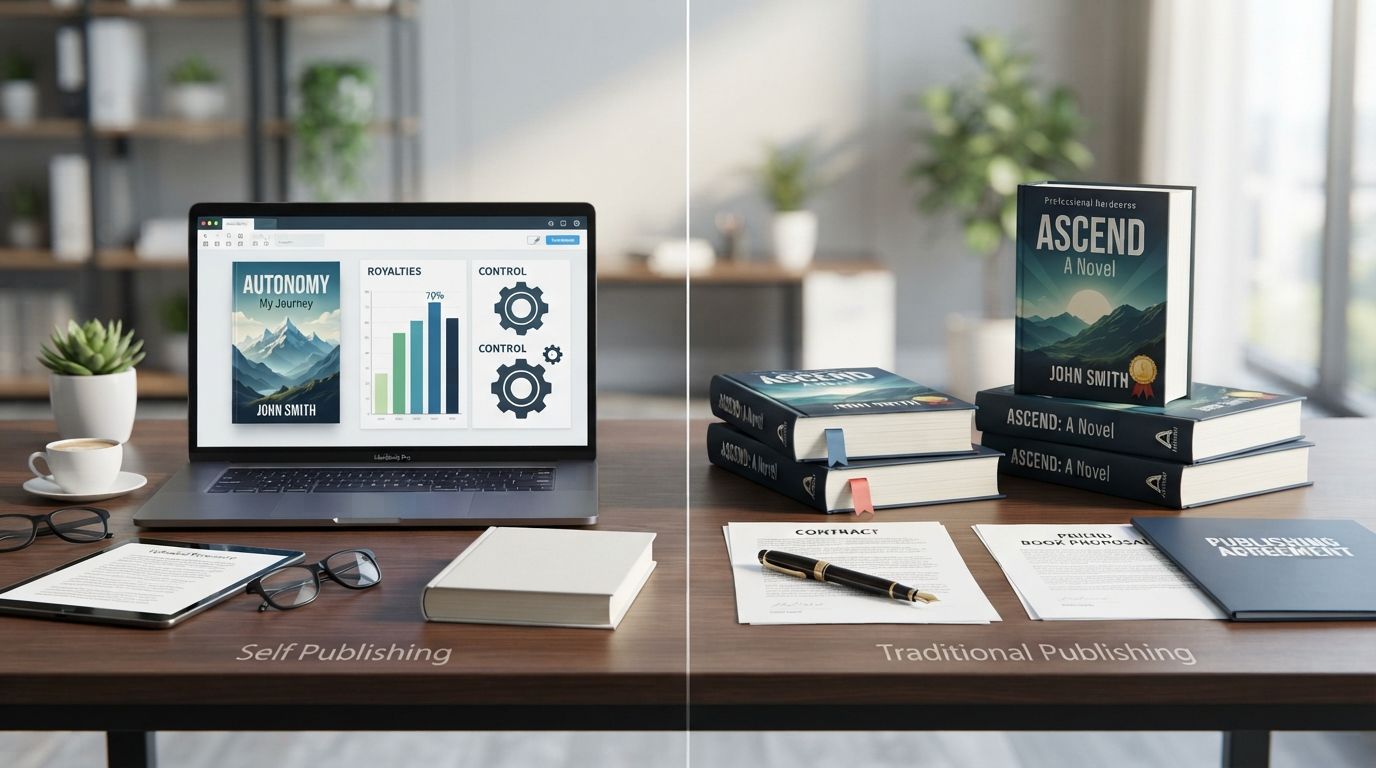
The global book publishing industry is undergoing a monumental transformation. Once dominated by elite legacy gatekeepers in New York and London, the landscape has democratized, giving rise to an era where authors hold unprecedented power over how, when, and where their work is published. In this dynamic environment, aspiring and established authors alike face a defining career decision: Should they pursue the prestigious, time-honored route of legacy houses, or should they seize control of their intellectual property through independent distribution? Weighing the dynamics of Self Publishing Vs. Traditional Publishing: Pros & Cons is no longer just a preliminary exercise—it is a critical business decision that dictates an author’s financial trajectory, creative freedom, and long-term career viability.
According to recent industry data, the self-publishing market is projected to grow at a compound annual growth rate (CAGR) of over 12% through the next decade, fueled by the expansion of digital platforms, audiobooks, and direct-to-consumer sales. Concurrently, traditional publishing remains a multi-billion-dollar juggernaut, leveraging unparalleled physical retail distribution, mainstream media access, and institutional prestige. However, the boundaries between these two pathways are blurring. Hybrid models have emerged, and “hybrid authors”—those who strategically use both models—are capturing significant market share. To make an informed decision, writers must look past the romanticized myths of both paths and analyze the cold, hard realities of contracts, distribution channels, royalty structures, and marketing requirements.
This comprehensive guide offers a deep-dive analysis of Self Publishing Vs. Traditional Publishing: Pros & Cons. Whether you are a debut novelist aiming for the New York Times bestseller list, a non-fiction expert looking to leverage a book for high-ticket consulting, or a prolific genre fiction writer seeking to maximize monthly cash flow, this article provides the data, strategic frameworks, and objective insights required to navigate the modern publishing landscape successfully.
What is Traditional Publishing?
Traditional publishing is the legacy model of book production and distribution. Under this system, an author sells the exclusive right to publish their manuscript to a publishing house (ranging from the “Big Five”—Penguin Random House, HarperCollins, Simon & Schuster, Macmillan, and Hachette—to mid-sized independent presses and academic publishers). In exchange for these rights, the publisher assumes all financial risk, manages the entire production pipeline, and pays the author royalties based on book sales, typically after recouping an initial monetary advance.
The Traditional Acquisition Process
Securing a traditional publishing contract is a rigorous, multi-stage process that can take months or even years, with no guarantee of success. The journey typically begins with the acquisition of a literary agent. Authors must draft a compelling query letter and, for fiction, submit a polished, completed manuscript. For non-fiction, authors must write an extensive book proposal detailing the target market, competitive analysis, marketing plan, and sample chapters.
Once an agent agrees to represent the author (taking a standard 15% commission on all domestic earnings), they begin the “submission” phase. The agent pitches the manuscript to acquisitions editors at various publishing houses. If an editor falls in love with the project, they must pitch it to their internal editorial and sales boards to secure approval for an offer. If multiple publishers are interested, an auction may ensue, driving up the advance. Once an offer is accepted, the project enters a lengthy contract negotiation phase, followed by a production cycle that typically spans 12 to 24 months before the book finally hits the shelves.
The Pros of Traditional Publishing
- Prestige, Validation, and Industry Recognition: For many writers, the validation of being selected by a major publishing house is unmatched. Traditional publishing grants access to prestigious literary awards, mainstream media reviews (such as the New York Times Book Review), and elite literary festivals that remain largely closed to self-published authors.
- Substantial Upfront Advances: Traditional publishers pay an advance against royalties. This is guaranteed money paid to the author before the book is published, typically split into installments (e.g., on signing, on acceptance of the final manuscript, on paperback publication). Even if the book fails to sell enough copies to earn out the advance, the author keeps this money.
- Unrivaled Physical Distribution: Traditional publishers have established relationships with major retail buyers, independent bookstores, libraries, and big-box retailers (like Target and Costco). Getting physical books onto shelves nationwide is a highly complex logistical feat that traditional houses execute seamlessly.
- Professional In-House Production: Authors receive the services of world-class developmental editors, copyeditors, proofreaders, cover designers, and metadata specialists at no personal cost. The publisher invests capital to ensure the book meets the highest industry standards.
- Zero Upfront Financial Risk: The publisher bears 100% of the financial risk. If the book fails to sell, the author is not personally liable for the costs of editing, printing, distribution, or marketing.
The Cons of Traditional Publishing
- Loss of Creative Control: When you sign a traditional contract, you yield final decision-making power. The publisher has the ultimate say over the book’s title, cover design, pricing, formatting, and even structural plot elements. If their vision conflicts with yours, you have very little recourse.
- Low Royalty Rates: Traditional royalty rates are significantly lower than self-published rates. Authors typically receive 5% to 10% on mass-market paperbacks, 7.5% to 15% on trade paperbacks, and 10% to 15% on hardcovers. Audiobook and ebook royalties generally hover around 25% of net receipts.
- Extremely Slow Time-to-Market: The traditional publishing pipeline is notoriously slow. From the moment you sign a contract, it often takes 18 to 24 months for the book to be released. This lag makes it difficult to capitalize on rapidly changing market trends.
- High Barriers to Entry: The gatekeeping system is incredibly restrictive. Literary agents and editors reject upwards of 99% of submissions. Talented writers can spend years in “query trenches” without ever securing a contract.
- Restrictive Contractual Clauses: Traditional contracts often include non-compete clauses, options clauses (giving the publisher first right of refusal on your next book), and rights-reversion clauses that make it incredibly difficult to reclaim your intellectual property, even if the book goes out of print.
What is Self-Publishing (Indie Publishing)?
Self-publishing, often referred to as independent or “indie” publishing, is a model where the author bypasses traditional gatekeepers to act as the publisher of their own work. The author retains 100% ownership of their intellectual property, finances the entire production and distribution process, and reaps the majority of the financial rewards. Rather than doing everything themselves, successful indie authors act as project managers, hiring freelance professionals to handle editing, cover design, and formatting, while utilizing global digital distribution platforms to reach readers.
The Modern Self-Publishing Ecosystem
The indie publishing landscape is powered by sophisticated print-on-demand (POD) technology and digital marketplaces. Instead of printing thousands of physical books upfront and storing them in a warehouse, POD platforms print books individually as customers order them. The primary engines of this ecosystem include Amazon Kindle Direct Publishing (KDP), which commands the lion’s share of the ebook and digital audiobook market; IngramSpark, the leading distributor for physical books to independent bookstores and libraries; and aggregate distributors like Draft2Digital, which push books to alternative retailers such as Kobo, Apple Books, and Barnes & Noble.
The Pros of Self-Publishing
- High Royalty Rates and Earning Potential: Self-published authors retain a massive percentage of their sales. Digital platforms like Amazon KDP pay up to 70% royalties on ebooks priced between $2.99 and $9.99. On print books, royalties often range from 40% to 60% of the retail price minus printing costs. This means an indie author can make far more money selling fewer copies than a traditionally published author.
- Complete Creative and Editorial Control: As the publisher, you retain ultimate authority. You choose your editors, design your cover, set your price, run your promotional campaigns, and write exactly what you want without editorial interference or compromise.
- Rapid Time-to-Market: Once your manuscript is edited and formatted, you can publish it globally within 24 to 72 hours. This agility allows indie authors to rapidly capitalize on trending genres, write topical non-fiction, or execute rapid-release strategies (publishing multiple books a year) to build a highly profitable backlist.
- Perpetual Rights Ownership: You never have to worry about your book going “out of print” or fighting to reclaim your rights. You retain your global rights indefinitely, allowing you to license translations, audiobooks, and film adaptations on your own terms.
- Direct Access to Reader Data: Indie authors can build direct relationships with their audience. By utilizing mailing list sign-ups, direct-to-consumer sales platforms (like Shopify or Kickstarter), and advanced digital analytics, they can track buyer behavior, optimize their marketing funnels, and build a highly loyal fan base.
The Cons of Self-Publishing
- Upfront Capital Requirements: To produce a book that rivals the quality of a traditional house, you must invest your own money. High-quality developmental editing, copyediting, proofreading, professional cover design, and formatting can cost anywhere from $1,500 to $5,000+ per book.
- Sole Responsibility for Marketing and Sales: Publishing your book is only 10% of the battle. The remaining 90% is marketing. Indie authors must master digital advertising (Amazon Ads, Meta Ads, BookBub), email marketing, search engine optimization, social media promotion, and public relations. If you do not market, your book will languish in digital obscurity.
- Distribution Obstacles in Physical Bookstores: While platforms like IngramSpark make your book technically “available” for bookstores to order, physical retailers rarely stock self-published titles unless the author actively pitches local managers or can prove massive regional demand. Store owners are highly hesitant to stock books that are not easily returnable.
- The Burden of Administrative Overhead: Self-publishing is a business. Authors must handle tax compliance, purchase ISBNs, register copyrights, manage freelancers, run accounting software, and handle customer service if selling directly. This administrative burden can detract from actual writing time.
- Varying Quality and Stigma: Because there are no gatekeepers, millions of low-quality, unedited books are uploaded to digital platforms every year. While the “indie stigma” has largely vanished among readers, some elements of the traditional literary establishment still look down on self-published works.
Self Publishing Vs. Traditional Publishing: Pros & Cons Comparison
To help you visualize the core differences between these two pathways, we have compiled a comprehensive comparison table analyzing the critical operational, financial, and strategic variables of both models.
| Feature/Metric | Traditional Publishing | Self-Publishing (Indie) |
|---|---|---|
| Upfront Costs | $0 (Publisher covers all editorial, design, and distribution expenses). | $1,500 – $5,000+ (Author pays for editing, cover design, formatting, and marketing). |
| Royalty Rates | Print: 5% – 15% of retail/net. Ebook: 25% of net receipts. |
Print: 40% – 60% minus print costs. Ebook: up to 70% of retail price. |
| Advances | Yes (Ranges from $1,000 for small presses to six/seven figures for major deals). | No (Earnings begin with the very first sale). |
| Time to Market | 12 to 24 months from signing the contract. | 24 to 72 hours once production is complete. |
| Creative Control | Minimal (Publisher has final veto over cover, title, edits, and pricing). | Absolute (Author controls all creative, pricing, and distribution decisions). |
| Physical Distribution | Excellent (Direct access to brick-and-mortar bookstores, libraries, and airports). | Limited (Available online and via catalog order; rarely stocked on physical shelves). |
| Marketing Responsibility | Shared (Publisher provides initial push; author must still do heavy lifting). | 100% Author-driven (Author must fund, execute, and manage all marketing). |
| Rights Ownership | Publisher owns exclusive rights for the duration of copyright (often life + 70 years). | Author retains 100% of all global rights and subsidiary licensing opportunities. |
A Deep-Dive Financial Comparison
To truly understand the economics of Self Publishing Vs. Traditional Publishing: Pros & Cons, let us look at a realistic financial simulation. Imagine a trade paperback priced at $15.00 and an ebook priced at $4.99. Let us compare the net earnings of a traditionally published author versus an independent author selling a modest 5,000 copies of each format (10,000 total books sold).
Scenario A: The Traditionally Published Author
The author secures a $10,000 advance. The publisher prints and distributes the books. Let’s look at the royalties:
- 5,000 Paperbacks Sold ($15.00 retail): At a standard 7.5% royalty rate, the author earns $1.125 per paperback. Total paperback earnings = $5,625.
- 5,000 Ebooks Sold ($4.99 retail): The publisher receives net receipts (roughly 70% of retail after Amazon’s cut) of $3.49. The author receives a 25% royalty on net receipts, which is $0.87 per ebook. Total ebook earnings = $4,350.
- Total Accrued Royalties: $5,625 + $4,350 = $9,975.
Because the total accrued royalties ($9,975) are less than the initial $10,000 advance, the author does not receive any additional royalty checks. The literary agent takes their 15% commission ($1,500) from the advance. The author’s net take-home pay is $8,500.
Scenario B: The Self-Published Author
The author invests $3,000 upfront for professional editing, cover design, and formatting. They distribute using print-on-demand and direct retail platforms:
- 5,000 Paperbacks Sold ($15.00 retail): Through Amazon KDP or IngramSpark, printing costs are roughly $4.50 per book. The retailer takes a 40% cut ($6.00). The author’s net profit is $4.50 per paperback ($15.00 – $4.50 – $6.00). Total paperback earnings = $22,500.
- 5,000 Ebooks Sold ($4.99 retail): The author receives a 70% royalty directly from Amazon, which is $3.49 per ebook. Total ebook earnings = $17,450.
- Gross Earnings: $22,500 + $17,450 = $39,950.
- Net Profit (Minus Upfront Production Costs): $39,950 – $3,000 = $36,950.
Even if we allocate an additional $5,000 for paid marketing and advertising campaigns, the self-published author’s net take-home pay is $31,950.
This financial simulation highlights why many authors are migrating to independent publishing. While traditional publishing offers the safety net of an upfront advance, the long-term earning potential of self-publishing, particularly for authors with a consistent output, is mathematically far superior.
The Rise of Hybrid Publishing and Assisted Self-Publishing
As the publishing landscape has matured, the clear-cut boundary between self-publishing and traditional publishing has given way to a spectrum of alternative models. For authors who want the best of both worlds, these intermediary paths offer intriguing possibilities—but they also carry significant risks.
Defining True Hybrid Publishing
A legitimate hybrid publisher operates under a collaborative business model. Unlike traditional publishers, who pay for everything, and self-publishing, where the author manages everything, hybrid publishers split both the financial risks and the rewards. The author pays an upfront fee to cover the costs of editing, design, and production. In return, the hybrid publisher handles all the logistics, utilizes their established distribution networks to get physical books into retail spaces, and pays the author a much higher royalty rate than a traditional publisher (typically 50% to 80% of net receipts).
According to the Independent Book Publishers Association (IBPA), a reputable hybrid publisher must adhere to strict professional standards, including:
- Vetting submissions (they must reject low-quality submissions, unlike vanity presses).
- Providing professional-grade editorial and design services.
- Securing robust distribution that reaches physical retail markets.
- Managing metadata and sales reporting transparently.
Warning: Beware of Predatory “Vanity” Presses
The rise of self-publishing has unfortunately spawned a predatory industry of “vanity presses” or “subsidy publishers.” These entities present themselves as traditional or hybrid publishers but are actually designed to exploit hopeful authors. They charge exorbitant upfront fees (often ranging from $5,000 to $15,000) for sub-par services, lock up the author’s rights in restrictive contracts, and provide zero real marketing or distribution support.
To protect your intellectual property and financial resources, look out for these critical warning signs of a vanity press:
- Aggressive Sales Tactics: High-pressure sales calls, constant emails, and unsolicited flattery about your manuscript.
- Guaranteed Bestseller Status: Any publisher promising to make your book an overnight bestseller is lying. No one can guarantee sales.
- Charging for Basic Services Individually: Forcing you to buy expensive, low-value packages (e.g., press releases, movie-pitch packages, or social media setup fees).
- Lack of Vetting: Accepting your manuscript within hours of submission without any editorial feedback or critique.
How to Choose the Right Path for Your Book
Choosing between self-publishing and traditional publishing is not a matter of finding the “best” model; it is about finding the model that aligns with your specific goals, resources, personal strengths, and book genre.
1. Analyze Your Book Genre
Different genres thrive in different ecosystems.
- Genre Fiction (Romance, Sci-Fi, Fantasy, Thrillers): These genres are highly suited for self-publishing. Readers of genre fiction are voracious, fast-reading digital consumers who devour multiple books a month. Indie authors can leverage rapid-release strategies and digital advertising to build massive, highly profitable backlists.
- Literary Fiction, Memoirs, and Children’s Books: These genres generally fare much better in traditional publishing. Literary fiction and memoirs rely heavily on prestige, reviews from major media outlets, and literary awards. Children’s picture books require expensive, high-quality color printing and rely almost exclusively on physical bookstore and school library distribution networks.
- Business and Non-Fiction: This can go either way. If your primary goal is to use your book as a calling card to secure high-ticket speaking engagements, consulting clients, or corporate credibility, traditional publishing offers the instant authority you need. However, if you already have a large existing audience or email list, self-publishing allows you to capture maximum profit margin and control the launch timeline.
2. Evaluate Your Financial Resources and Risk Tolerance
Do you have the capital to invest in your book up front? If you have a budget of $2,000 to $5,000 and are comfortable running a business, self-publishing allows you to treat your book as a startup venture. If you have zero capital and cannot afford to pay for professional editing or cover design, pursuing a traditional contract is your safest route, as the publisher absorbs all initial production expenses.
3. Assess Your Technical and Entrepreneurial Skills
Are you excited by the prospect of managing a business, running digital ad campaigns, analyzing sales data, and hiring freelancers? If so, you have the mindset of an indie author. If the idea of marketing, formatting, and administrative business management fills you with dread, and you simply want to focus on the craft of writing, traditional publishing is likely a better fit.
Key Takeaways: Navigating Your Publishing Journey
- Traditional publishing offers unmatched prestige, physical bookstore distribution, and zero upfront financial risk, but requires giving up creative control, enduring slow timelines, and accepting low royalty rates.
- Self-publishing provides maximum creative freedom, rapid time-to-market, and exceptionally high royalty rates (up to 70%), but requires upfront capital investment and absolute responsibility for marketing and business operations.
- The financial math shows that while traditional advances are appealing, an independent author can generate far greater net profits with moderate sales than a traditional author selling the same volume.
- Hybrid models can bridge the gap for authors seeking professional assistance and distribution, but writers must remain highly vigilant to avoid predatory vanity presses.
- Your genre and goals should dictate your path. Fast-paced genre fiction thrives in the indie space, while literary fiction, memoir, and children’s books still heavily rely on traditional publishing channels.
- “Hybrid” is the future. Many modern authors do not limit themselves to one path; they self-publish their fast-release series while traditionally publishing their standalone novels or non-fiction books to maximize their reach and revenue.
Frequently Asked Questions
Is it harder to sell books traditionally or self-published?
Selling books is challenging in both models, but the nature of the challenge differs. In traditional publishing, the hardest part is passing the initial gatekeepers (securing an agent and a publisher). Once published, you have professional distribution, but you must still actively market to stand out. In self-publishing, publishing is instant, but the challenge lies entirely in marketing. You must build your own audience from scratch and compete against millions of other titles on digital platforms.
Can I self-publish a book and then get it traditionally published later?
Yes, but it is rare and usually requires exceptional circumstances. Traditional publishers will generally only acquire a self-published book if it has already demonstrated massive, verifiable commercial success (typically selling tens of thousands of copies on its own). Famous examples include Andy Weir’s The Martian and E.L. James’s Fifty Shades of Grey. If a self-published book has poor or mediocre sales, traditional publishers will view it as a proven commercial risk and will rarely touch it.
Do self-published books have copyright protection?
Absolutely. In most jurisdictions (including the US, UK, and EU), copyright is established automatically the moment you write your book in a tangible medium. Whether you self-publish or publish traditionally, you own the copyright. To secure legal advantages, such as the ability to sue for statutory damages in court, self-published authors should register their copyright officially with their country’s copyright office (e.g., the U.S. Copyright Office).
How much does it cost to self-publish a book professionally?
To produce a book that is indistinguishable from a traditionally published bestseller, you should expect to invest between $1,500 and $5,000. This budget typically breaks down as follows: developmental and copyediting ($800 – $2,500), professional book cover design ($300 – $1,000), professional formatting ($150 – $400), and initial marketing/launch expenses ($200 – $1,000). Cutting corners on editing or cover design is the most common reason self-published books fail to sell.
Who decides the retail price of a self-published book?
As a self-published author, you have complete control over your book’s pricing. You can adjust the price at any time using your distribution dashboards. Most indie authors price their ebooks between $2.99 and $9.99 to maximize royalty rates (Amazon pays 70% in this range) and price trade paperbacks between $12.99 and $17.99, depending on the page count and printing costs.
Conclusion
The debate surrounding Self Publishing Vs. Traditional Publishing: Pros & Cons is no longer about which path is “better.” Instead, it is about which model fits your unique goals as a creative professional. Traditional publishing still offers an unmatched level of cultural prestige, professional editing, and physical storefront placement. For authors whose primary dream is to see their book in airport bookstores or to win major literary awards, the traditional query trench remains a path worth fighting through.
Conversely, self-publishing has transformed from a last-resort option into a highly lucrative, sophisticated business model. For entrepreneurial authors who value creative control, rapid production, direct reader relationships, and high royalty margins, indie publishing offers an unprecedented vehicle for building a sustainable, profitable career on your own terms.
Ultimately, the power lies in your hands. Many of today’s most successful authors are refusing to limit themselves to a single path. By embracing a hybrid approach—retaining digital rights to self-publish niche projects while partnering with traditional houses for mass-market distribution—you can leverage the strengths of both systems. Assess your resources, analyze your genre, define your personal version of success, and take action. The literary world is waiting for your story.


